
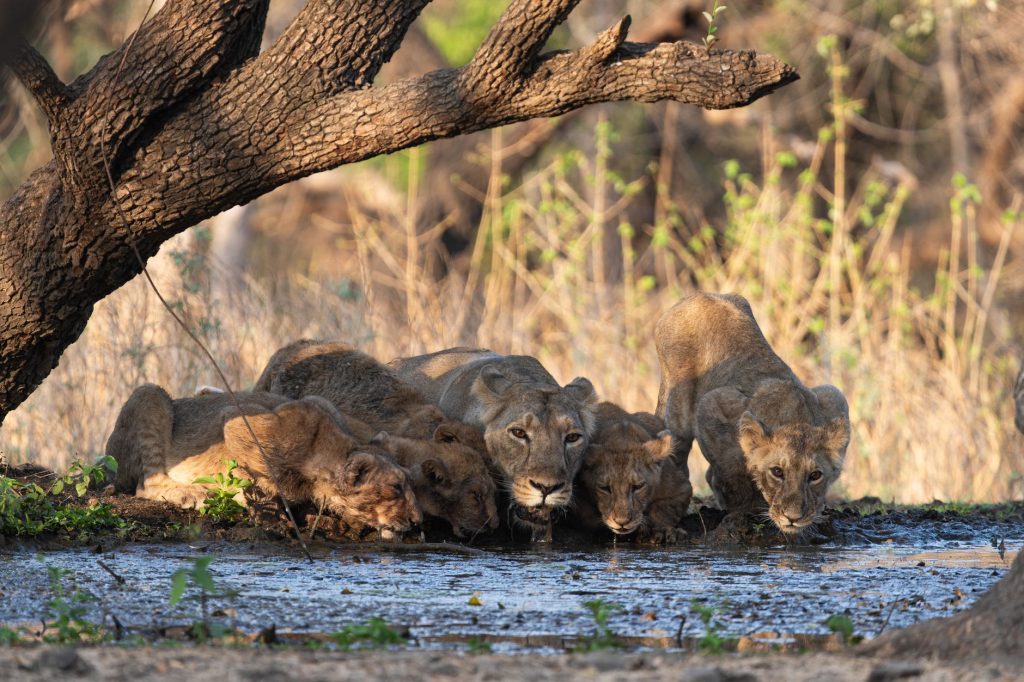
Are Gujarat’s villages turning against the state’s prized wildlife?
As the latest data reveals, many rural areas in Gujarat have seen a significant decline in Asiatic lions – the state’s national animal – in the past few years. But what’s behind this worrying trend?
Decline of the Pride: A Reality Check
The Asiatic lion, also known as the Indian lion, has been a symbol of Gujarat’s wildlife heritage for decades. However, recent reports from the state’s forest department indicate a sharp decline in lion populations in many rural areas. In 2020, the total lion population in Gujarat stood at 674, but by 2022, this number had dwindled to 568.
While the exact reasons behind this decline are still being investigated, local residents and wildlife experts point to several factors, including habitat loss, human-wildlife conflict, and lack of effective conservation efforts.
‘The lions are being forced out of their natural habitat due to the increasing human population and agricultural activities in the area,’ said Dr. Prakash, a wildlife expert based in Ahmedabad. ‘The villages are getting closer to the lions’ habitat, leading to frequent conflicts between humans and animals.’
Local villagers also claim that the state government’s efforts to protect the lions have been inadequate. ‘The government has not done enough to protect our land and crops from the lions,’ said a villager from Kuno Wildlife Sanctuary. ‘We have lost many animals and crops to the lions, and the government has not provided us with any compensation.’
The situation is further complicated by the state government’s ambitious plan to develop the Gir Forest National Park, a key habitat of the Asiatic lions, into a major tourist destination. While the plan aims to boost the local economy, it also raises concerns about the potential impact on the lion population.
Wildlife experts warn that the decline of the Asiatic lion in Gujarat could have far-reaching consequences for India’s biodiversity. ‘The lions are an important part of our ecosystem, and their disappearance could lead to a ripple effect on other species,’ said Dr. Meena, a conservation biologist.
Human-Wildlife Conflict: A Growing Concern
Human-wildlife conflict is a major contributor to the decline of the Asiatic lion in Gujarat. As the lion population shrinks, villagers are increasingly coming into conflict with the animals over land, crops, and livestock. In many cases, the conflict escalates, resulting in the killing of both humans and animals.
‘We have had several cases of humans and lions being injured or killed in conflicts,’ said a forest official. ‘The situation is becoming increasingly dire, and we need to take immediate action to address the issue.’
Efforts are underway to mitigate the conflict, including the deployment of forest guards and the establishment of compensation schemes for villagers who lose livestock or crops to lions. However, more needs to be done to address the root causes of the problem.
A comprehensive approach that takes into account the needs of both humans and animals is needed to save the Asiatic lion in Gujarat. This could include measures such as habitat restoration, community engagement, and the development of sustainable livelihoods for local villagers.
What’s Next for Gujarat’s Wildlife?
The decline of the Asiatic lion in Gujarat is a worrying trend that requires immediate attention. The state government needs to take a comprehensive approach to address the issue, including habitat restoration, community engagement, and the development of sustainable livelihoods for local villagers.
‘The future of the Asiatic lion in Gujarat hangs in the balance,’ said Dr. Prakash. ‘If we don’t act now, we may lose this iconic species forever.’
The government and conservation organizations must work together to protect the lions and their habitat. This includes engaging with local communities, supporting sustainable livelihoods, and addressing the root causes of human-wildlife conflict.
Only through a collaborative effort can we ensure the long-term survival of the Asiatic lion in Gujarat and preserve the state’s rich wildlife heritage for future generations.
As the situation continues to unfold, one thing is clear – the future of Gujarat’s wildlife hangs in the balance. Will we act in time to save the Asiatic lion, or will it become a relic of the past?